Wednesday, October 5, 2011

The Relative Strength Concept of Common Stock Price Forecasting

The Relative Strength Concept of Common Stock Price Forecasting, an evaluation of selected applications of stock market timing techniques, trading tactics, and trend analysis
by Robert A. Levy

Book Description: Investors Intelligence, Inc., Larchmont, NY, 1968. Hardcover. 1st Edition. 8vo - over 7¾ - 9¾" tall. Hardcover, Blue cloth boards with gilt title to cover and spine, top edge blue, numerous charts, graphs, table and diagrams, First Edition, 1968.

Book Condition:
Very Good, slightest shelfwear, corners gently bumped, back cover, top edge slightly dust dulled, previous owner name in black ink to front endpapers, spine slightly cocked (1/32"), binding tight, slight tanning to endpapers, pages and text block, otherwise clean and free of marks,

Dust Jacket Condition:
Good, extremely tanned, moderate soil to covers and spine, some dampstaining to spine, 1/2" x 1/2" tear to top of spine (see photos), price intact (NOT price clipped)

Contents:
Acknowledgments, Introduction, Issues and Problems, The Theory of Random Walk: A Preview, Technical Stock Market Analysis, Conceptual Reasoning vs. Empirical Evidence, Research Methodology - Security Analysis and the Computer, Value and Importance, Format, Chapter 1: Technical vs. Fundamental Analysis, Chapter 2. The Theory of Random Walks, Chapter 3: Construction of the Data File, Chapter 4: Selecting a Frame of Reference, Chapter 5: Relative Strength as a Criterion for Investment Selection, Chapter 6: Cast Out Models: The Principle of Portfolio Upgrading, Chapter 7: Variable Ratio Formula Plan Models, Chapter 8: Some Suggested Models for Portfolio Management, Chapter 9: Summary and Conclusions, Appendices, Bibliography. -- end. Early First Edition title on Relative Strength by Levy, 318 pages, Collectible.

Buy Now:
$225.00


Robert A. Levy
circa 1968

Economic Reports from Cycles January 1977 - October 1981

Economic Reports from Cycles January 1977 - October 1981
by Foundation for the Study of Cycles

Book Description: Foundation for the Study of Cycles, Pittsburg, PA, 1981. No Binding. 4to - over 9¾ - 12" tall. REPRINT, velo-bound, 8.5 x 11 in. black text on standard white paper, clear blue plastic cover,

Book Condition:
Very Good, very good photocopy of original documents, all text, charts and diagrams legible. no dust jacket, page corners creased at top corner of last 30 pages, some soil to covers and text blocks, approx. 175p.

Contents: Excellent collection of cycle reports published by the Foundation for the Study of Cycles (Edward R. Dewey) on topics that include, Interest Rates, Residential Construction Contracts, Consumer Price Index, The Long Wave in American Economic History, Gold Prices, Silver Prices, Lead Prices, Corn Prices, Oats Prices, Soybean Prices, Egg Prices, Cattle Prices, Timber, Lumber Prices, Steel Prices, Coal Prices, Stock Prices in Constant Dollars, 40-Month Cycle in Stock Prices, The 4.8-Year Cycle in Stock Prices, The Trend and Long Cycle on Stock Prices. Excellent Reference Material on cycles, approximately 175 pages.

Buy Now:
$50.00


Tuesday, October 4, 2011

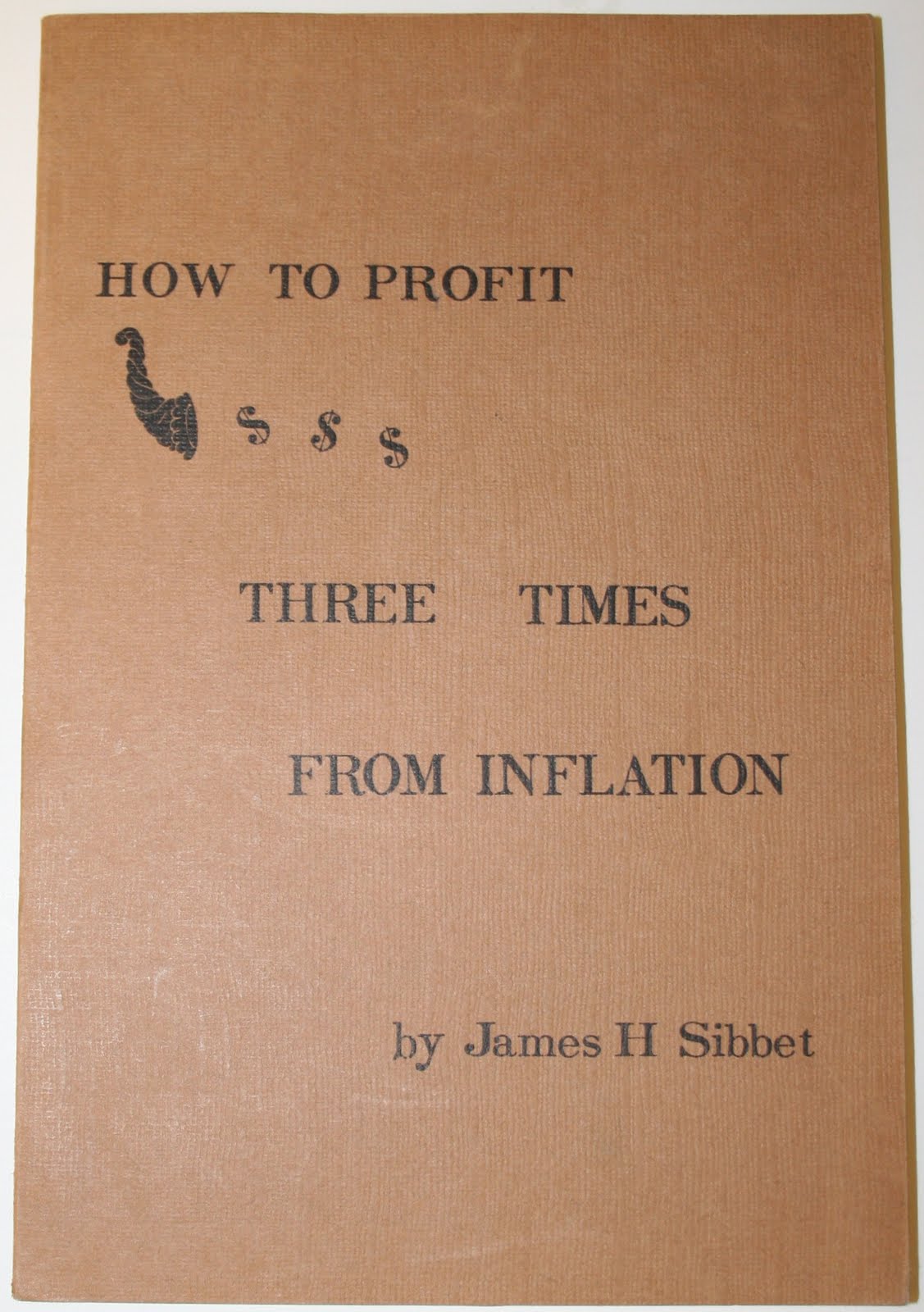
How to Profit Three Times From Inflation

How to Profit Three Times From Inflation
James H. Sibbet

Book Description: Sibbet Publishing Company, Pasadena, 1969. Soft cover. 8vo - over 7¾ - 9¾" tall. Softcover, Trade Paperback, Textured Tan wrappers with black lettering to cover, 1969. Transcription of the seminar at the Embassy Auditorium - Given by James H. Sibbet on September 14, 1966, 7.5 x 1.5 in. tab laid-in to page 7 shows exponential increase in National Debt,

Book Condition: Good, light shelf wear to edges, corners and spine, previous owner name in blue pen to front endpapers, blue pen underlining to Preface, but no underlining to main text. (note: the publisher has used black underlining to highlight important points), no dust jacket,

Contents:
Very scarce title by James H. Sibbet who is most noted for being the first to quantify contrary opinion and trade based on that data. This book is a transcript of a seminar he held in September 1966 on how to profit from inflation. He notes that the reader should first read his book "Mortgages and Bonds Are in Jeopardy" to first understand what inflation is and it's causes and cures. The function of this seminar (book) is to take up where others leave off and explain how to ride the inflation elevator three times or more so as to parlay your profits into a fortune by shrewdly switching from one leveraged inflation hedge to another at the proper times. Highly Recommended. Extremely Scarce Title by James H. Sibbet who also ran an advisory service called "Market Vane" in the 1960's referenced in books such as Alexander Elders' "Trading for a Living." - 85 pages + Appendix. (We also have a 1967 First Edition of this title in Very Good Condition available for sale on HERE)

Buy Now:
$95.00


James H. Sibbet circa 1967

FORECASTING THE NEW YORK STOCK MARKET

FORECASTING THE NEW YORK STOCK MARKET Being a Treatis on the Geometrical or Chart System of Forecasting In Which is Explained the Principles of the Art, and, in this Lesson No. 1, Giving a Demenstration With the Price Curve of Potatoes in U.S.
by Professor (Donald) Weston

Description:
Donald Weston, Washington D.C., 1921. No Binding. 4to - over 9¾ - 12" tall. REPRINT, Loose pages 8.5 x 11 in. black text on standard white paper, no binding, (Original self published by Professor Weston in 1921),

Reprint Condition: Very Good, clean photocopy of original manuscript, all text, charts and diagrams legible. No dust jacket,

Contents:
Reprint of a very rare manuscript on Forecasting Stock Market movements using Astrology, and one of the first titles on Financial Astrology. This is a favorite among W.D. Gann Students.

General consensus within the astro-economic community traces the primary development of modern financial astrology to around the 1920s, the first time Gann mentioned a planet being in a 1921 Forecasting Course. Professor Weston's breakthrough work, Forecasting the New York Stock Market, also dates from 1921 to 1923, and in the 1920s Sepharial produced most of his known Arcana or Keys to the markets, though he states in his advertisements that these systems had been in development since 1898.

Professor Weston represents the earliest application of Fourier Sequences to market analysis, by breaking down component cycle waves and combining them to produce a composite model. Weston was a regular contributor to Frederick White's journal, The Adept. Weston was also one of the first to propose a theory of the 10 year cycle, actually with two different versions of the ten year pattern. The first is his computation based on 50 years of data, of a series composed of 14, 20 and 28 months, called the Venus term and based upon the Heliocentric system. The second is a sequence which divides the Jupiter/Saturn cycle into 10 irregular parts, but follows the Geocentric system. Professor Weston was a great influence on Gann, implied by his manuscript being locked in Gann's safe, and he may have been the one who introduced Gann to Fourier cycle theory, providing Gann with the foundation for his 10 year cycle with its multiples.

Extremely Scarce, REPRINT, Collectible.

Buy Now:
$45.00


Sunday, October 2, 2011

Dr. Jerome Baumrings Supplementary Reading List

PART 1: Baumring Scientific & Metaphysical Reading List
PART 2: Baumring Financial Market Reading List, Primary Recommendations
PART 3: Baumring Financial Market Reading List, Secondary Recommendations
PART 4: Dr. Jerome Baumring Bio
PART 5: References and Resources

PART 1: Baumring Scientific & Metaphysical Reading List
Dr. Baumring compiled numerous works useful for explaining every aspect of the markets, expanding Gann’s list of recommended works. These books were carefully selected to elucidate primary aspects of knowledge essential for an understanding of Gann’s Market Cosmology.

The Apocalypse of the Golden Mean; Hugh Riscoe, 1960, 30p. This is the most important book on the golden mean and its true meaning and relationship to ancient architecture and the universe. Jerry considered this book so important that he kept it locked away and never released it to any of his students. (A softcover reprint with full sized maps is available here for $80.00)

Nature’s Harmonic Unity;
Samuel Colman; 1911; 327p. Probably the best book on the harmonic ordering processes of nature. Filled with beautiful harmonic diagrams, and highly recommended by Dr. Baumring.

Proportional Form: Further Studies In The Science Of Beauty, Being Supplemental To Those Set Forth In "Nature’s Harmonic Unity"; Colman, Samuel; Coan, C. A.; 1920; 265 pages. This is Colman’s 2nd work completed two years before he died. It is an important companion to Nature’s Harmonic Unity, and one of the best books on order and geometry in nature.

The Lodge and the Craft; Rollin Blackmer; 1923; 287p. As stated by Dr. Baumring, this book contains one of the Three Keys to Gann. This is one of the few Masonic books which contains explicitly important knowledge and has direct connections to Tunnel Through the Air.

Behold! The Circle Squared Beyond Refutation; Heisel and Faber; 1934; 238p. The solution to the squaring of the circle, giving numerical proportions meaningful to the market.

Spiritism: The Hidden Secret in Einstein’s Theory of Relativity;
Clara A. Speight-Humberston; 1915; 232p. This was one of Dr. Baumring’s secret books formative in his understanding of the markets. It relates cellular life with alchemy and sacred numbers.

The Lost Solar System of the Ancients Discovered, 2 Vols.; John Wilson; 1856; 1000p. This was one of Dr. Baumring’s most highly recommended books and is one of the best sources of information on market cosmology, number series, astronomy and ancient architecture.

New Laws For Natural Phenomena;
Thomas Graydon; 1938. This was one of the main books on Dr. Baumring’s reading list. It goes into cosmic order and laws of astronomical harmony.

The Emerald Tablets of Thoth The Atlantean; Doreal, 1939; 140p. This was another of Dr. Baumring’s goodies that he talked about but refused to release. These are the amazing translations of the original Emerald Tablets written by Hermes Trismegistus in Ancient Egypt, which were recovered by Doreal in a Mayan temple in the Yucatan and returned to the Hall of Records.

The Sun Book; John Hazelrigg; 1916.

Astrosophic Tractates;
John Hazelrigg; 1936.

Secrets of the Meridian;
Alec Stuart; 1926.

The Septiform System of the Cosmos; Alec Stuart; 1935.

Kabbalistic, Alchemical and Occult Symbolism of the Great Pyramid; Doreal; 1939.

Handbook of Mathematics; J. Claudel; 1906; 708p. This book was chosen by Jerry to give a complete mathematics introduction to his students. It covers completely all that is needed in arithmetic, algebra, trigonometry, and calculus.

Ancient Mysteries and Modern Revelations; W. J. Colville; 1916; 352p.

The Magic of Numbers; Eric Temple Bell; 1946;418.

Kabbalah; W. J. Colville; 1916; 190p.

Sunspots and Their Effects; Harlan True Stetson; 1937; 200p.

Other Worlds Than Ours; Richard Proctor; 1880; 328p.

Astrosophic Principles; John Hazelrigg; 1917.

The Book of Enoch The Prophet; Richard Laurence; 1838; 250p.

Mystic Symbolism In Bible Numerals; Leo Stalnaker; 1952; 150p.

The Last Shift of the Earth’s Axis; Fred G. Plummer; 1894.

Introduction to the Theory of Sets; Joseph Breuer; 1964.

Planetary and Stellar Worlds; Gen. O. M. Mitchel; 1891; 182p.

Cleoparta’s Needle; James King.

Stars Ahead; Ray and Josephine Smyth.

The Alchemy of Light and Color;
Oliver Reiser; 1928.

New Astronomy and Cosmic Physiology; G. E. Sutcliffe.

Io Unveiled; Bozena Brydlova; 1922. A wonderful book highly recommended by Dr. Baumring.

Key To The Bible; Harry Walton; 1952.

Secret: The Gizeh Pyramids;
Thothmu Tastmona; 1954. One of Dr. Baumring’s most highly recommended books on the pyramid.

Hand-book of Astrology;
Zadikiel; 1863.

Eclipses and Lunations in Astrology; Sam Bartolet; 1937.

Periodicity: The Law of All Life;
Buchanan; 1912. This book was stored in the depth of Dr. Baumring’s files and has obviously great applications to the market.

The Science of Numerology Through the Law of Vibration;
John Laurie. Another out of Dr. Baumring’s files never before released.

Pychoscopy;
Hashnu Hara; 1905. This one also from Dr. Baumring’s files.

Why Life Exists; Lars Carlson; 1930; 224p. This one also out of Dr. Baumring’s private files.

The Symphony of Life;
Donald Hatch Andrews; 1966; 423. From Dr. Baumring's reading list.

Long Range Astro Weather Forecasting;
George McCormack; 1965. Also from Dr. Baumring’s files.

The Web of the Universe;
E. L. Gardner; 1960. A great book on universal lattices.

PART 2: Baumring Financial Market Reading List
Primary Recommendations: These were the books recommended by Dr. Baumring to his students as the most essential and important books for any student of the markets and particularly of forecasting. They are the all time classics of Technical Analysis and fundamental to any market education.

W.D.Gann Complete Writings

Investing For Profit With Torque Analysis of Stock Market Cycles; William C. Garrett; 1973. One of the greatest and deepest technical analysis books ever written, out of print and unattainable for the last 20 years.

Graphs and Their Application to Speculation; Geo. W. Cole; 1936; 278p. Dr. Baumring had Gann’s own personal copy of this book in which Gann had marked numerous sections some of which he extracted and included in his own works.

Technical Analysis and Stock Market Profits; Richard Schabacker; 410p. The all-time classic on technical analysis and market formations. Stock Market Profits; Richard Schabacker; 1934; 342p.

George Wollsten: Expert Stock and Grain Trader; George Bayer; 1946; 235p. Bayer probably had the next deepest understanding of the esoteric aspect of the market after Gann, making his works quite valuable.

Turning 400 Years of Astrology to Practical Use; George Bayer; 1944; 184p. This book gives insight into how Bayer did astrology, how to use it in the market.

Tubbs’ Stock Market Correspondence Course; Frank Tubbs. One of the best courses on technical analysis discussing the famous Tubbs bottom.

Benner’s Prophecies of Future Ups and Downs in Prices;
Samuel Benner; 1879. Probably the earliest book on market forecasting and one of the finest.

Nature’s Law: The Secret of the Universe;
R. N. Elliot; 1946. This book extends Elliot’s wave principle by connecting it to universal phenomena, and natural order.

The Wave Principle; R. N. Elliot; 1938. This is the original work on the Elliot Wave by its discoverer.

"The Wave Principle": A Series of Articles Published in 1939;
R. N. Elliot. Another exposition of the famous principle by its founder.  A 3 Volume Set with all of of Elliots titles is available here

Pickell-Daniel Extension Course of Grain Market Analysis; Pickell and Daniel; 1937; 400p. One of the greatest courses on grain market analysis includes weather pattern analysis and compass projections.

Seven Studies in Stock Market Trading;
M. V. Woods; 1943. Important explanation of the real meaning of periodicity.

Wyler Series on Stock Market on Stock Market Speculation: Vol.1 The Application of Scientific Principles to Stock Speculation; Vol.2 Trading and Trending; Joseph A. Wyler; 174&215p. These books explain the markets in terms of Newtonian mechanics.

Planetary Effects on Stock Market Prices; James Mars Langham; 1932; 179p. This book and its companion volume are the two best books on financial astrology.

Cyclical Market Forecasting Stocks and Grains; James Mars Langham; 1938; 191p.

Economic Cycles Their Law and Cause; Henry Ludwell Moore; 1914; 114p.

Forecasting the Yield and the Price of Cotton; Henry Ludwell Moore; 1917; 173p.

Generating Economic Cycles; Henry Ludwell Moore; 1923; 141p.


PART 3: Baumring Financial Market Reading List
Secondary Recommendations: These books, though secondary recommendations, are still some of the best, if not the only books on market analysis available. Dr. Baumring required that the most serious students read the books on this list as well as those on the previous list.

The One-Way Formula For Trading Stocks and Commodities;
William Dunnigan;1957. This along with the I-S Method were considered by Dr. Baumring to be the two best trend following systems ever developed, with which one could make good profits even without the ability to forecast.

New Blueprints For Gains In Stocks and Grains;
William Dunnigan; 1954; 150p.

Gains in Grains; William Dunnigan; 1952.

Barometers For Forecasting Stock Prices;
William Dunnigan.

The Elliot Wave Principle: A Critical Appraisal;
A. Hamilton Bolton; 1960; 115p.

Stock Market Prediction; Donald Bradley; 1948.

The Long Waves In Economic Life; N. D. Kondratieff; 1944.

The ABC of Options and Arbitrage; S. A. Nelson; 1904.

Relative Strength and Stock Market Timing;
Daniel Merkle; 1966 128p.

A New Technique of Stock Market Forecasting; C. S. Johnson; 1931.

The Great Bull Market and Collapse;
National Graphic Co.; 1932.

Action-Reaction Signals;
Edwin S. Quinn; 1950.

Basic Trend Barometer; Emil Schultheis; 1946; 200p.

Speculation As A Fine Art;
Dickson F. Watts; 1865. Very Rare.

Minor Swings of the Stock Market And Their Indications;
B. Edlin; 1924.

How Money Is Made In Security Investments;
Henry Hall; 1908; 240p.

An Introduction to Trend-Action;
Richard Martin; 1943.

I Like the Depression; Henry Ansley; 1932. A humorous book describing the pleasures of the depression.

Psychology of the Stock Market; G. C. Sedlin; 1912.

Magic of Making Money In The Stock Market; Clif Stewart; 1951.

The "Todd Theory" of Market Measurement and Price Projection;
Payson Todd; 1953.

The Psychology of Speculation; Henry Harper; 1926.

When to Sell To Assure Profits;
James P. Morton; 1926; 158p.

Wall Street: Its Mysteries Revealed Its Secrets Exposed;
William C. Moore; 1921; 144p.

What Makes Stock Market Prices; Warren Hickernell; 1932; 200p.

Safe Methods of Stock Speculation;
William Stafford; 1902.

PART 4: Dr. Jerome Baumring Bio
by Bradstreet Stewart
This biography by Brad Steward appeared in Traders World #27 in 1999 under the title, Gann Harmony, The Theories & Teachings of Dr. Jerome Baumring

There has recently been a resurgence of interest in the forecasting principles of W. D. Gann and correlatively the interpretation and explanation of Gann provided by the late Dr. Jerome Baumring of the Investment Centre. It is common for the new (and old) student of the Gann methodologies to be overwhelmed by a mass of disordered and conflicting material regarding the mythic figure and cryptic teachings of this great market master, W. D. Gann. The only proponent of the application The Law of Vibration to financial market forecasting since Gann himself was Dr. Jerome Baumring of the Investment Centre. There has been enough curiosity and confusion regarding Dr. Baumring to warrant a more detailed elaboration and clarification of the history and theories of this visionary analyst and philosopher.

Donald Mack, a highly respected market historian and scholar, founder of the Investment Centre Bookstore stated, "In our capacity as book suppliers to the world in our specialist area of stock and commodity books, we have met many who have been trying to fit together the pieces of the puzzle that is Gann. However, no one to our knowledge has come close to solving the mysteries inherent to the Gann methodology except for Dr. Baumring, whom we saw evolve from his initial introduction to Gann to a complete mastery some years later. So much so that we unequivocally state that he is the only person we know of that has solved every aspect that Gann wrote about."


Don Mack in a 1983 newspaper ad for The Investment Centre Bookstore

Dr. Baumring was introduced to Gann while in traction recovering from a car accident which severely injured his spine (ultimately the cause of his untimely death). While in the hospital, someone gave him a copy of Perry Kaufman’s Commodity Trading Systems and Methods in which is presented a copy of Gann’s May Soy Beans chart which caught his eye. Dr. Baumring noticed on this chart a tiny almost indistinguishable point and arc which had been drawn with a compass on the chart. This sparked a flame in his imagination leading him to commit the next three years, 16 hours a day, 7 days a week to the understanding of Gann’s trading methodologies.

It was evident to Dr. Baumring that Gann was using techniques which were not outrightly presented in his courses, and that the key to deciphering his cryptic writings lay in an understanding of "how Gann used words". He realized that he would have to study everything that Gann himself had studied in his time in order to obtain a frame of reference coincident with that of the Master. Dr. Baumring approached Donald Mack and requested the use of his massive investment library, while accumulating an extensive personal library of old scientific, metaphysical and market works which Gann most likely would have had access to himself. Dr. Baumring read over 5,000 books in those years, a feat only accomplished with the help of a photographic memory and an ability to read 1,800 words a minute.

After three years of indefatigable research, even with his expertise in pharmacology and mathematics, his gift as a mechanic, and a background in Zen and martial arts, he had hit an unassailable wall. Faced with the prospect of failure, he awoke late one night to hear an inner voice direct him to his charts. As he sat down at his chart table, this voice walked him step by step through the final barriers to understanding.

After this breakthrough and its integration into a complete system which he called "Gann Harmony", Dr. Baumring turned to the markets to prove the validity of the system. He began with a $25,000 account and in less than two years compounded his investment into over a million dollars. Having proven that the system was capable of producing the promised returns, he then verified that it was applicable to all markets, doing a full analysis of and trading 18 futures markets and a selection of stocks. In order to prove Gann’s theories on a larger scale, Dr. Baumring traded for a silver hedging company. This was the time when the gold and silver markets exploded to their all time highs. Dr. Baumring had forecast the top of the silver market to within a three minute window, and implemented a sophisticated strategy allowing him to transition from a position 200 contracts long to a position of 200 contracts short in a screaming exponential market. As the timing point for the top approached with the market moving as only commodities do at all time highs, a gentleman he was advising was hesitant to sell at the timing point and asked if he could wait another minute. His hesitation cost him $60,000.

In an interview in the Herald Examiner on February 4, 1986, Dr. Baumring stated, "From now to the end of the third quarter, the market will be sideways or down, perhaps some 200 points (on the Dow). Then we expect a rally like 1927 to 1929, to 3000 or more by 1988 or 1989. There will be 400 million-share days on the market." At that time such high volume and volatility were unheard of, but a year and a half later when Black Monday scared the pants off of Wall Street, Dr. Baumring just smiled as he had been short five S & P options from the last high and had just made $120,000.

With his understanding of the markets now complete, Dr. Baumring began looking for another challenge. One of the unfortunate byproducts of his new understanding was the lack of people capable of communicating on a stimulating level. Like Gann, Dr. Baumring also felt an obligation, what he often referred to as a "karmic debt", to, as Gann said, pass on the enlightenment that had been heaped on himself in abundance. There seemed to be one resolution, to share his understanding of "Gann Harmony". Teaching this system would certainly be a challenge, would balance his "karmic debt", and at worst, would develop some stimulating interaction. We think it best to let Dr. Baumring describe for himself the results of his decision, so the following quotes have been extracted from his seven page announcement of a series of Courses he called The Investment Centre Stock & Commodity Courses – A Distillation of the Insights and Wisdom of W. D. Gann. (the complete Announcement can be viewed on the Internet at www.sacredscience.com)

"Beginning with this announcement of our coming very thorough Course of Instruction in W. D. Gann’s almost unknown methods of analysis of stocks and commodities, we feel very strongly we must resolve the misinformation and misconceptions of this great, great man’s exceptional methodology. To put a stop to so much that has been wrongly propagated (generally by mostly sincere people) as to what Mr. Gann’s approach involved (such as astrology, angles, his numbered squares, cardinal crosses, and on and on), we unequivocally state that to the best of our knowledge nobody to date has ever dealt with, or has been able to even accurately explain The Law of Vibration which Mr. Gann with great authority said was the key to explain all phases of market action. Without properly understanding the basic laws relating to Vibration, of what value could any or all of the propagated so-called Gann concepts possess?"

"This Course begins with a thorough examination of The Law of Vibration, and thereafter progresses to Number Set Theory (Numerology), followed by the Law of Proportion as demonstrated by Geometrical applications, and going onward into the areas vital to Gann analysis such as harmonics, the mathematics of music, angles… When the area of Angles is studied,… (we) will clear away for the first time the misuse of the technique that has been propagated as " Gann Angles". To accomplish this we will turn to Gann’s own writings where he states in no uncertain terms that there is much more than just the Diagonal Angle, or as he says, ‘There are three kinds of angles – the vertical, the horizontal and the diagonal angle, which we use for measuring time and price movements’. Of the three, the diagonal angle is the least important."

Dr Baumring’s approach to interpreting Gann was to follow Gann’s clues and clear indications as to what were the necessary topics in need of understanding and application. Gann’s well known Ticker Interview (this full interview can be viewed at www.sacredscience.com) states very clearly that the foundations of his system were mathematics, chemistry, physics, astronomy, harmonics, natural philosophy, "the universal law of causation and harmony", wireless telegraphy, etc., all summed up in the Law of Vibration. He was continually amazed to find that most Gann students and "experts" have very little knowledge in even one of these fields, let alone in all of them. How can one possible expect to understand Gann’s methodologies when one does not even understand the most fundamental principles upon which Gann says his system is based? How can one possibly be expected to predict the future when one does not even understand the principles and laws which govern the present? There is no question that without a thorough understanding of these principles it is IMPOSSIBLE to understand Gann! Dr. Baumring’s approach was to thoroughly educate his students in every field necessary to develop an understanding of the Universal System of cause and effect founded upon the Law of Vibration. He made this easier for his students by personally selecting from over 5,000 books the clearest and most easily accessible presentations of the exact concepts needed for an understanding of Gann’s methods. These presentations were collected together into a series of Notebooks which Dr. Baumring presented to his students along with required reading lists necessary to elaborate the concepts into a complete understanding.

In his lectures, Dr. Baumring would tie these principles together with demonstrations in the markets leading the student to the integration of a complete Universal System, or Cosmology. He presented a number of perspectives and concepts which had never before been considered, though fundamental to Gann, such as the markets being, at minimum, a three-dimensional phenomena, exactly like a large molecule rotating in space, in and out of the Z plane, with DNA coding sequences governing the entire process. Without understanding that the market is 3-D, twisting like a plant governed by the phyllotactic laws of dual number series and harmonic composition and decomposition, all measurements taken on a 2-D chart become misleading. He translated the "mystic" terms of the esoteric tradition into modern counterparts: "astrology" becoming "numerical astrophysics, celestial mechanics, or optics", "numerology" becoming "number set theory", "mystic symbolism" becoming "symbolic logic", "sacred geometry" becoming "lattice and matrix theory or the projective geometry of light". He often mentioned that these different branches of knowledge were merely various manifestations of One Phenomenon in differing forms of Symbolic Logic.

Dr. Baumring taught using a methodology unlike those of our modern educational systems. He believed that in order for knowledge to reside as inherent knowing, an individual must recreate the process of discovery within himself. Jerry would regularly comment, "I am merely the Sherpa (guide, way-shower), you must walk the path yourself." This attitude is based upon the Christic principle he often quoted of "Give a man a fish and you feed him for a day; teach a man to fish and you feed him for life." He made clear that even if he were to explain the entire process outright, it would be of no avail, for without the catalyzing power of insight attained only through personal discovery, the student would be unable to digest and integrate the principles. Now this does not mean, as many students and Gann seekers fear, that it takes some form of Divine Grace or Mystical Revelation to perceive the true workings of the market. Rather the process of study and research develops an insight into the necessary principles of Cause and Effect, Natural Law and its manifestation in reality, which are absolute prerequisites for an integrated understanding and application.

Robert Miner wrote, "I have been lucky. Over a decade ago my most influential teacher of market analysis and trading, Dr Jerome Baumring who has since passed away, taught me to not only look at the market from radical new perspectives, but to prove everything out myself."

On a personal note, no mention of Jerry Baumring is complete without a few comments about his delightfully eccentric character. Jerry was the type of person who naturally used words such as "happenstance", "prestidigitation" and "isness". He was a master mechanic, and I more than once arrived for a lesson to find him elbow and undershirt deep in grease with his car disassembled on the ground. I would read while he put it back together, and to this day I carry a book everywhere I go, just in case. He drove an old Cougar and an old Mustang, and when I asked why he didn’t buy himself a decent car, he guffawed saying that the older cars were built with much greater quality than the newer ones, which contained unfixable computers and plastic parts, whereas he had built his cars with his own hands.

He had a similar fetish for his photocopy machines. In 1986 the copy machines did not have simple components and had to be taken apart to be cleaned, and many a night Jerry could be found past midnight with the copy machine in pieces all over the room. When told him he was wasting his time performing tasks a technician could do, he replied that by doing this himself he had learned that the gold wire in the copy mechanism was based upon the same principle used in the sarcophagus of the Great Pyramid to perform teleportation by the projection of plasma energy through the crystalline capstone.

Jerry’s primary form of R&R was book hunting all over the world. He would climb ladders and crawl on filthy floors digging into the deepest, darkest, spider-infested corners, and I’ll be damned if he didn’t always come up with some jewel everyone else had missed. He was a spontaneous not a methodical book collector. Jerry would stop at a garage sale and find some amazing first edition for a dollar while also buying the broken toaster for ten cents because the power cord was worth two dollars. As he toted his booty, toaster under one arm, book open in the other hand, upon mention that buying the toaster seemed silly, he would reply that it was a 2,000% return on his investment, and that didn’t include the book.

From the last anecdote it is not difficult to understand the continual state of his house and office. I once pulled out a chair from his book-piled dining room table, looking for a seat, only to find the chair laden with too many books to inconspicuously move. He hid his best books in his dresser with the most rare beneath his underwear. In the corner next to his side of the bed was a 3 foot high and deep waterfall of books deposited there after his evening reading. His office was in a continual state of disheveled flux due to the massive amount of information continually being processed.

Dr. Baumring’s work hours were 8:00 AM to 4:00 AM Monday through Sunday structured by a 100% spontaneous schedule. As a private student one could expect regular phone calls between 1-4 AM, and lessons scheduled for 8:00 AM would often begin past midnight, or would occur in a distant hotel room while on a book hunting expedition. Strangely enough, the best lessons and deepest insights often occurred on the most unlikely occasions. Private students generally went through about 100 books a year, always finding or being given better and better material when ready. There is no student of Dr. Baumring’s who does not acknowledge the profound impact he has had upon their understanding of the Universe.

The current state of Dr. Baumring’s teachings, students, library and the like warrants clarification. Upon Jerry’s death, his widow, Dr. Wendy Baumring, was determined to assure that her late husband’s work and materials would remain available both to his students and to all those seeking a fundamental understanding of the methodologies of W. D. Gann or of the Universal theories upon which his methods are based. The Sacred Science Institute (also known as the Glass Bead Game) was formed in cooperation with Mrs. Baumring for the purpose maintaining the accessibility of the teachings and research materials of Dr. Baumring. All of Dr. Baumring’s Notebooks containing his selections of conceptual presentations necessary for understanding Gann, as well as his complete reading lists, Gann’s recommended reading list, and the most complete collection of writings of the great Market Masters considered important by Dr. Baumring are currently and will remain permanently available. We have also organized a complete set of Lecture Notes of over 250 pages of Dr. Baumring’s direct teachings from all Nine Seminars, soon to be followed by the availability of several hundred pages of Lecture Notes from the lessons of private students. These have been released to provide the serious student with the resources and direction necessary for an understanding of Gann.

Dr. Baumring’s library also remains completely intact, and will be preserved in conjunction with two further libraries with a total of over 10,000 volumes, one of the most complete cosmological libraries in the world. From these libraries the rarest and most important books in every field of metaphysics, science, cosmology and the markets have been selected for publication with around 200 titles available now and another 400 to be added in 1999.

Dr. Baumring was very strict about presenting Gann in his most original and complete format. In response to these desires, we have released a series of Unpublished Writings of W. D. Gann, containing his most important works, never before available to the public due to their rarity, and organized in the original manner as presented by Gann. They include Gann’s unpublished course on the Master Time Factor which he sold for $2,500 in 1939, and a number further unpublished forecasting courses, providing a complete supplement to the material currently available through Lambert-Gann. We have compiled a scientific collection including a series of courses written months before Gann’s death delineating his Mathematical Formula for Market Predictions and including, for the first time, the complete instructions for Gann’s Mathematical Price Time & Trend Calculator, as well as three other calculators with instructions. Gann students will be surprised at the added clarity derived from having Gann’s most important writings organized in their intended format.

Currently, there are a greater number of serious students of the theories of Gann as presented by Dr. Baumring than when he was alive and there will soon be an Internet forum created online to facilitate the communication and interaction of people engaging in serious research in various branches of Cosmological theory including Financial Market Forecasting. The Sacred Science Institute is committed to permanently providing the best and most complete research materials to the seeker of Universal understanding. -- Bradstreet Stewart


PART 5: References and Resources

Likely the best resource for some of the materials above is through Brad Stewart at sacredscience.com. Brad Stewart was a student of Dr. Baumring in the 1980's and has done a wonderful job of preserving and making available many of the titles on Dr. Baumring's list as well as expanding offers on deeper topics to better understand the workings of the universe.

For W.D. Gann material, Cody Jones at wdgann.com is by far the best source for materials on Gann. They continue to make more and more original Gann material available to the public.

Saturday, October 1, 2011

Paths to Wealth Through Common Stocks

Paths to Wealth Through Common Stocks
by Philip A. Fisher

Book Description: Prentice-Hall, Inc., Englewood Cliffs, NJ, 1960. Hardcover. 1st Edition. 8vo - over 7¾ - 9¾" tall. Hardcover, 1/4 Green cloth X Ivory cloth with gilt title to cover and spine, First Edition, 1960.

Book Condition:
Very Good, corners gently bumped, slightest soil to covers, light shelfwear, spine straight, binding tight, endpapers and pages clean and free of marks, top dust dulled, some tanning and light soil to text blocks,

Dust Jacket Condition:
Good, (in Mylar), price clipped, small tear to spine (about 1/2" - see photos), covers rubbed, light soil, moderate shelfwear,

Contents: Preface: The Need for Additional Investment Books, Part I: Adjusting to the Key Influences of the 1960s, Part II: How the Greatest Increases in Stock Values Come About, Part III: You and Where Your Investment Business Must Go, Part IV: Trivia, But Not Entirely, Part V: Major Growth Industries of the 1960s. -- end. First Edition of a Classic by Fisher. Highly Collectible.

Buy Now:
$79.00


The Dynamics of Business Cycles: A Study of Economic Fluctuations

The Dynamics of Business Cycles: A Study of Economic Fluctuations
by Jan Tinbergen, translated by J.J. Polak

Book Description: The University of Chicago Press, Chicago, IL, 1950. Hardcover. 8vo - over 7¾ - 9¾" tall. Hardcover, Orange cloth boards (possibly a faded red) with gilt title to spine, top edge red, An Analysis by Jan Tinbergen, (Translated from the Dutch and Adapted for American Use by J.J. Polak, based on Economische Bewegingsleer first published in the Netherlands by The North Holland Publishing Company, Amsterdam, 1942).

Book Condition:
Good, covers rubbed, faded and light soil, back board slightly warped ( very slight, you probably wouldn't have noticed unless I pointed it out), corners gently bumped, light shelfwear, endpapers and pages clean and free of marks,

Dust Jacket Condition: Fair, (in Mylar), large red stain on back cover that engulfs two thirds of the cover, covers tanned and light soil, tear to top front cover, spine extremely tanned, some chips along top of back cover otherwise solid, price clipped,

Contents:
PART I: DESCRIPTION, I: Introduction, Types of Movements, II. Long-Run Developments, III. Interruptions and Sudden Changes in Structure, IV. Cyclical Movements, V. Seasonal Fluctuations, VI. Random Movements, VII. Differences Among Individual Countries, VIII. Fluctuations in Individual Markets, PART II: The Explanation of Economic Fluctuations, IX. Economic Statics and Economic Dynamics, X. The Process of Long-Run Development, XI. Periods of War and Inflation, XII. Long Waves, XIII. Business-Cycle Fluctuations, XIV. Cyclical Movements in Individual Markets, XV. Exogenous Movements, XVI. Theoretical Postscript, PART III. BUSINESS-CYCLE POLICY, XVII. Introduction, XVIII. Objectives of Trend Policy and Business-Cycle Policy, XIX. Indirect Policies. I. Tax Policies, XX. Indirect Policies II. Other forms, XXI. Direct Policies. I. Expenditure Policies, XXII. Direct Policies. II. Other forms, XXIII. Summary: Choice of an Optimum Policy, Index. -- end.

A solid title on Business and Economic Cycles by Tinbergen, Collectible.

Buy Now:
$55.00


The Elliott Wave Principle of Stock Behavior: 1967 Supplement, A Supplement to Te Bolton-Tremblay Bank Credit Analyst

The Elliott Wave Principle of Stock Behavior: 1967 Supplement, A Supplement to Te Bolton-Tremblay Bank Credit Analyst
by A.J. Frost

Book Description:
Monetary Research Ltd., Hamilton, Bermuda, 1967. No Binding. 4to - over 9¾ - 12" tall. REPRINT, Loose pages 8.5 x 11 in. black text on white paper, no binding, photocopy of originally published in May 1967.

Book Condition:
Very Good, high quality copy of original, all text and charts crisp.

Contents: Foreword, Elliott's Basic Tenets, (1) Impulse and Corrective Waves, (2) Extensions, (3) Rule of Alternation, (4) Proportionate Analysis, (5) Volume, (6) Failures, (7) The Time Element, (8) Thrusts, (9) Tenets of Investing, Elliott and Bank Credit, Elliott and Cycle Theories - Benner, Aids to Interpreting Elliott, Where are we in the Stock Market Cycle?, Mathematical Basis of Wave Theory, Gold and Dross, - Includes numerous Diagrams and Charts. -- end.

Scarce Elliott Wave piece by A.J. Frost circa 1967. REPRINT.

Buy Now:
$20.00


The Elliott Wave Principle of Stock Market Behavior: 1964 Supplement, A Supplement to The Bolton-Tremblay Bank Credit Analyst

The Elliott Wave Principle of Stock Market Behavior: 1964 Supplement, A Supplement to The Bolton-Tremblay Bank Credit Analyst
by A. Hamilton Bolton

Book Description: 1964. No Binding. 4to - over 9¾ - 12" tall. REPRINT, Loose pages 8.5 x 11 in. black text on white paper, no binding, photocopy of originally published in May 1967.

Book Condition:
Very Good, all text and charts legible although a magnifying glass is recommended for the fine details on some of the charts.

Contents:
Chapter I: The Pattern of the Industrials, II. What about the Rails?, III. The Timing of Groups, IV. How About Individual Stocks?, Libby-Owens-Ford Glass, Admiral Corp, V. Conclusion, VI. Appendix - Elliott Notes on Selected Stock Patterns, Stock Chart Folio: American Airlines, American Machine & Foundry, American Motors Corps, American Photocopy Equipment Co, Bell Intercontinental, Bethlehem Steel, Brunswick Corp, Burroughs Corp, Cenco Instruments, Delta Airlines Inc., Korvette (E.J) Inc., International Business Machines, Lehigh Portland Cement Co. Lukens Steel Co., Peabody Coal Co., Polaroid Corp, Reynold Tobacco, Zenith Radio, Xerox Corporation --

Scarce Elliott Wave title by A. Hamilton Bolton circa 1964. REPRINT.

Buy Now:
$25.00


Tuesday, September 27, 2011

Marketonics: A Course on the Theory and Practice of Stock Market Trading and Investing

Marketonics: A Course on the Theory and Practice of Stock Market Trading and Investing
by George Seamans, Jack Hellum

Book Description: Seamans-Blake, Chicago, IL, 1956. No Binding. 4to - over 9¾ - 12" tall. REPRINT, 8.5 x 11 in. velo-bound, (originally published 1956), original was typewritten on Marketonics letterhead, includes numerous charts, graphs and tables, however this does NOT include the Cycli-Graph Book of Charts referenced in the lectures. 355 pages.

Book Condition: Very Good, Photocopy Reprint, all text, charts and graphs are legible. No dust jacket. Contents: Introduction, Lecture #1: Introduction to course methodology,(10 pages) Lecture #2: (15 pages), Lecture #3: (17 pages), Lecture #4: (14 pages), Lecture #5: (10 pages), Lecture #6: (11 pages), Lecture #7: which includes tables of Advances and Declines (22 pages), Lecture #8: topics include Chart Reading (15 pages), Lecture #9: topics include Trend (15 pages), Lecture #10 more on Chart Reading and Trend (16 pages), Lecture #11: Supply and Demand (14 pages), Lecture #12: Supply and Demand - Continued (18 pages), Lecture #13: Supply and Demand - Continued, The Long Term Trend (24 pages), Lecture #14: Supply and Demand - Continued, The Long Term Trend w/ stock data sheets (19 pages), Lecture #15: Objectives (15 pages), Lecture #16: Objectives - Continued (14 pages), Lecture #17: Long Term Objectives (11 pages), Lecture #18: New System, Lecture #19: Practical Objectives (14 pages), Lecture #20: X-Ray Chart example of 30-Day Supply and Demand Chart set-up (28 pages), Page 1-A: Master Lists; Investment Stocks, Cats and Dogs, Low Priced Stocks, Page 2-A: Master Lists; Volatile Stocks, Steel Stocks, Railroad Stocks, Page 3-A: Master Lists; Heavy Industrial Stocks, Page 4-A: Master Lists; Consumer Stocks, Oil Stocks, Lecture #20 Tables, X-Ray Chart, 9 Groups of Stocks used in the X-Ray Chart from 1949 to 1956, Supply and Demand Chart, Table of Advances and Declines from Lecture #20, Chart: Dow Jones Industrial Average 1951 to 1953, Data Sheets. -- end.

Summary:
Extremely Rare Course in Stock Trading and Investing by George Seamans (edited by George Seamans and Jack Hellum), Highly Collectible REPRINT (note: This reprint of the 20 course lectures does NOT include the accompanying Cycli-Graph book of charts referenced in the material).

About the Author:
Born in 1889, Eliyahu Bar-Daniyel [pseud. George Seamans] was a well respected trader and author of several stock market books in the 1930s through the 1950s. He later wrote two non-market related titles in Hebrew in 1957 and 1960. Stock Market titles included, The Seven Pillars of Stock Market Success (1938); Course in Stock Market Trading (early 1940s); This is the Road to Stock Market Success (1944); Success Stock Market Course (1952); Marketonics: A Course on the Theory and Practice of Stock Market Trading and Investing (1956); 

[Note: Windsor published 100 Rules on How to Trade Profitably (1973), but the text was originally published The Seven Pillars of Stock Market Success in 1938 by Seamans-Blake Publishers in 1938.
Windsor later published Seven Pillars a year later in 1939.]

Seamans first copyrighted the Marketonics Course June 18, 1956.

Buy Now:
$450.00


Friday, September 23, 2011

Buying and Selling Stocks for Profit: A Graphic Study and Explanation of Stock Price Movements Illustrated by 43 Charts

Buying and Selling Stocks for Profit: A Graphic Study and Explanation of Stock Price Movements Illustrated by 43 Charts
by Angelo Sestero

Book Description:
A. Sestero, 1933. No Binding. 4to - over 9¾ - 12" tall. REPRINT, loose pages 8.5 x 11 in., black text on white paper, (original published 1933), includes 43 charts, 78 pages.

Book Condition: REPRINT photocopy, reproduction quality is very good and fully legible. No dust jacket.

Contents:
Foreword, Charts, One Point Chart, Three Point Chart, Five Point Chart, One Eight of a Point Chart, Paper to Make Charts, Number of Charts Required, Trend Lines, Buying Formations of Accumulation, Market Experience, Taking a Long Position, How to Judge Distance, Consolidation Steps, Selling Formations of Distributions, Down Trend, Lines and Formations, Trading Market, Volume, Stop Loss Orders, Time Element, Trading Example, Taking Profit, Bulls and Bears, Pools, Tips, Trading on Margin, Profits and Losses, Conclusion. -- end.

Summary from the Foreword:
"The purpose of this book is to assist the investing public. Strictly speaking not all securities listed on the New York Stock Exchange can be looked upon as investments. Only a small percentage of them yield dividends and most of them are subject to wide fluctuations. It is in these fluctuations that the public is afforded an opportunity to make profits on commitments in common equities, and these same fluctuations all too frequently are the cause of severe losses. Hence, it is of the utmost importance to the individual to know something about the past, present, and future trend of the market. Charts afford an ample guide to the trends. As a mariner requires a compass on an ocean voyage to direct his course, so does the individual who trades in securities require a chart to determine the course of the market. The following pages explain by word and example how charts indicate the future trend of fluctuations in the stock market, as they have indicated them in the past."

Extremely Scarce and highly sought after title on technical analysis, self-published by Angleo Sestero in 1933. 78 pages. Collectible REPRINT.

Buy Now:
$125.00


Investors Research Book of Charts: July 1966 Edition

Investors Research Book of Charts: July 1966 Edition
by Investors Research Service

Book Description:
Investors Research Service Publsihers, Santa Barbara, CA, 1966. Soft cover. 8vo - over 7¾ - 9¾" tall. Softcover, Green vinyl 6 ring binder with gilt title to cover, 11.25 x 8.75 in., publshed July 1966.

Book Condition:
Good, substantial rubbing and soil to covers, moderate shelfwear, binding mechanism works perfectly and is aligned correctly, internally pages are in very good condition, pages are clean, bright and free of marks. No dust jacket.

Contents:
Introduction, SECTION I: MARKET ANALYSIS STUDIES, The Primary Trend, The Primary Trend Indexes, The Dow-Jones Industrials and NYSE Volume, INSERT: The Primary Trend Transparent Overlay Sheet (MISSING FROM THIS COPY, not included), Investors Research Averages - 550 Stock Average, 30-Investment Grade Average, 30-Low-Priced Average, The 40-Bond Average, The Dow-Jones 65-Stock Average, The Confidence Index, The 10-Week Advance-Decline Index, The 10-Week Hourly Upside-Downside Volume Index, The Odd-Lot Indexes, 18-Day Advance-Decline Index, 18-Day Breadth Index, 18-Day Volume Index, 6-Week Volume Index, SECTION II: INDUSTRY GROUP STUDIES, Interpreting Group Charts, Aircraft and Missiles, Airline, Aluminum, Amusement, Automobile, Automation, Auto Equipment, Baking, Banking, Building Material, Business Machines, Cement, Chemical, Coal, Container, Cosmetics and Toiletries, Drug Manufacturing, Electric Equipment, Farm Equipment, Finance, Food, Food Chain, Glass, Gold Mining, Individual Stock C.S. Index Chart, Insurance, Investment, Liquor, Machinery, Machine Tool, Meat Packing, Metal Fabricating, Mining and Smelting, Motion Picture, Nature Gas, Oil, Paper, Publishing and Education, Radio-Television, Railroad, Railroad Equipment, Retail Merchandising, Rubber, Science-Applied, Soft Drink, Steel, Textile, Tobacco, Utility, Variety Store, Vending Machine (The Industry Group Charts are 3 Year charts that run July 1963 to June 1966) -- end. 68 pages, Collectible Chart Book circa 1966.

Buy Now:
$75.00


Wednesday, September 21, 2011

Commodity Futures Markets and the Law of One Price

Commodity Futures Markets and the Law of One Price
by Arvind K. Jain

ISBN: 0877122105 / 0-87712-210-5

Book Description:
University of Michigan Division of Research, Ann Arbor, Michigan, U.S.A., 1980. Soft cover. 1st Edition. 8vo - over 7¾ - 9¾" tall. Softcover, Tan wrappers with title over red to cover and black title to spine, Library of Congress stamps to flyleaf (see photo),138 pages. Michigan International Business Studies, Number 16, Division of Research, Graduate School of Business Administration, No dust jacket.

Contents: Exhibits, Tables, Foreword, Acknowledgments, I. Introduction, 2. Past Studies of Integration and Price Movement, 3. A Model of Arbitrage in Commodity Markets, 4. Methodology for Testing the Model, 5. Data Analysis, 6. Conclusion, Appendix: Tables of Analysis of Community Prices, Bibliography. -- end. Extremely Scarce Title on Commodity Price Theory, Collectible.

Buy Now:
$75.00


The Curbstone Brokers: The Origins of the American Stock Exchange

The Curbstone Brokers: The Origins of the American Stock Exchange
by Robert Sobel

Book Description: The Macmillian Company, New York, 1972. Hardcover. 8vo - over 7¾ - 9¾" tall. Hardcover, Blue cloth boards with gilt title to spine, Third Printing, 1972, uncut edges, 296 pages, includes some photos and illustrations.

Book Condition:
Very good, covers lightly rubbed, corners gently bumped, edges slightly faded and soiled, small white blemish to spine (1/8"), spine straight, binding tight, internally clean, no marks to end papers, pages clean and bright, no marks to pages. Dust Jacket Condition: Very good, (in Mylar), covers rubbed and light soil, light shelfwear no rips or tears, price clipped,

Contents:
Preface, Introduction, I. Some Stayed Behind, II. The Rival Exchanges, III. Consolidation and the Consolidated, IV. Bucket Shops on Broadway, V. The Broad Street Jungle, VI. The Curb Community, VII. Mendels and the Establishment, VIII. The New York Curb Market, IX. The Boom Years, X. The Move Indoors, Postscript, An Essay on Sources and Methodology, Appendixes: I. Testimony of George E. Ely, II. Testimony of James B. Mabon, III. Testimony of Marcus Heim, IV. Testimony of Miguel E. De Aguero, V. Testimony of Frank Knight Sturges, VI. The Curb News, 1910-1911, Index. -- end. Informative and entertaining title on America's outdoor exchanges prior to them moving indoors in the early 1920s. 296 pages, numerous photos, Collectible.

Buy Now:
$60.00


One Hundred Years of Banking in Norwich Connecticut

One Hundred Years of Banking in Norwich Connecticut
by The Thames National Bank

Book Description:
The Thames National Bank, Boston, MA, 1925. Soft cover. 1st Edition. 12mo - over 6¾ - 7¾" tall. Softcover, Saddle stitch, Green marbled leathette-like card wrappers with gilt title to cover and brown decorative graphic and frame to cover, Printed in Commemoration of The One Hundredth Anniversary of The Thames National Bank, 1925, Complied, arranged and printed by direction of Walton Advertising & Printing Co., Boston, MA. 39 pages. 7.75 x 5 in.,

Book Condition: Very Good, light rubbing to covers, corners bumped, general shelfwear, internally pages show slightest hint of age tanning otherwise free of marks, no dust jacket.

Contents: Foreword, Norwich It's History and Its Growth, The Thames National Bank, Franklin Nichols (President 1851-1890), Charles Bard (Cashier 1857-1871), Edward N. Gibbs (President 1890-1897, Cashier 1871-1889), Stephen B. Meech (President 1897-1909, Cashier 1889-1894), Charles W. Gale (Vice-President 1918-1919, Cashier 1894-1918, William A. Briscoe (President 1909-1913), Charles L. Hubbard (President 1913-1918), Arthur H. Brewer (President 1918-1923), Oliver L. Johnson (President 1923-1925+), William B. Young (Vice-President 1923-1925+), Nathan A. Gibbs (Cashier 1918-1925+), John Porteous (Director 1903-1925+), Grosvenor Ely (Director 1909-1925+), Arthur M. Brown (Director 1915-1925+), James L. Hubbard (Director 1918-1925+), Walter F. Lester (Director 1921-1925+), Hugh B. Campbell (Director 1922-1925+), Frank B. Ricketson (Director 1923+), William G. Park (Director 1924-1925+), List of Officers of the Bank since 1825, Present Directors (1925) - end.

Extremely Scarce piece of Thames Banking History in Norwich, Connecticut published in 1925. Includes B&W photos of Directors and Bank Exterior and Interior, 39 pages. Collectible.

Buy Now:
65.00


A History of Interest Rates: 2000 B.C. to the Present (1963)

A History of Interest Rates: 2000 B.C. to the Present (1963)
by Sidney Homer

Book Description: Rutgers University Press, New Brunswick, NJ, 1963. Hardcover. 1st Edition. 8vo - over 7¾ - 9¾" tall. Hardcover, Red cloth boards with gilt title to spine, First Edition, 1963, 617 pages.

Book Condition: Very Good, slightest bump to corners, light shelfwear, spine extremes lightly bumped, some soil to text blocks, top dust dulled and light foxing to top, slightest hint of tanning to endpapers and internal pages, otherwise free of marks, spine straight, binding tight,

Dust Jacket Condition:
Good, covers rubbed and soiled, moderate shelfwear with a few small rips and tears to edges, none larger than 1/2", edges chipped in a few places non larger then 3/16",

Contents:
Acknowledgments, Summary Tables, Charts, Introduction, PART ONE. ANCIENT TIMES: Chapter I. Prehistoric and Primitive Credit and Interest, II. Mesopotamia: Sumer, Babylonia, and Assyria, III. Greece, IV. Rome, V. A Summary and Analysis of Ancient Interest Rates, PART TWO. MEDIEVAL AND RENAISSANCE INTEREST RATES: VI. Usury Doctrines and Their Effect on European Credit Forms and Interest, VII. The Dark Ages, VIII. Late Medieval Times, IX. The Renaissance, X. A Summary and Analysis of Medieval and Renaissance Interest in Western Europe, PART THREE. MODERN EUROPE AND NORTH AMERICA TO 1900: XI. England in the Eighteenth Century, XII. Europe in the Eighteenth Century, XIII. England in the Nineteenth Century, XIV. France in the Nineteenth Century, XV. Other European Countries in the Nineteenth Century, XVI. The United States in the Eighteenth and Nineteenth Centuries, PART FOUR. WESTERN EUROPE AND NORTH AMERICA SINCE 1900: XVII. The United States in the Twentieth Century, XVIII. England in the Twentieth Century, XIX. Europe in the Twentieth Century, XX. Canada in the Twentieth Century, XXI. Summary and Analysis of Interest Rates in Western Europe and North America Since 1900, PART FIVE. OTHER COUNTRIES: XXII. China, XXIII. Japan, XXIV. Russia, XXV. Modern Italy, Austria, Portugal, Spain, Turkey, Egypt, Norway, and Denmark, XXVI. Sterling Area: Australia, New Zealand, South Africa, Ireland, India, and Pakistan, XXVII. Latin America, Notes, Index -- end. Extensive tables (81) and charts (73).

Synopsis: A History of Interest Rates presents a very readable account of interest rate trends and lending practices over four millennia of economic history. Despite the paucity of data prior to the Industrial Revolution, author Homer provides a highly detailed analysis of money markets and borrowing practices in major economies. Underlying the analysis is his assertion that the free market long-term rates of interest for any industrial nation, properly charted, provide a sort of fever chart of the economic and political health of that nation. Given the enormous volatility of rates in the 20th century, this implies we're living in age of political and economic excesses that are reflected in massive interest rate swings.

About the Author:
Sidney Homer was a partner in the investment firm of Salomon Brothers & Hutzler, New York. A graduate of Harvard, he was formerly president of Homer & Co., Inc., bond dealers, then manager of the institutional department of the investment counsel firm of Scudder, Stevens & Clark. Mr. Homer's entire business career since the 1920's had been directed to dealings in financial instruments. He has published numerous reports and analysis of contemporary interest rate trends which have been followed closely by many institutional investors. He devoted twenty-five years to compiling the data for this history, in the course of which he has consulted and been assisted by many scholars, bankers, and government officials here and abroad.


Sidney Homer circa 1963

-- Highly Collectible First Edition. (book covers interest rates up to 1963).

Buy Now:
$95.00


Win With Losers: How to Reap the Reward of Stock Market Riches


Win With Losers: How to Reap the Reward of Stock Market Riches

by Thomas May

Book Description: Snail Books, Las Vegas, NV, 1978. Soft cover. Book Condition: Good. 1st Edition. 8vo - over 7¾ - 9¾" tall. Softcover, Trade Paperback, Black printed wrappers with White title to cover and spine, First Edition, First Printing, January 1978, 112 pages. Book Condition: Good, moderate rubbing to covers, some chips to edges, corners bumped, binding tight, internally clean and free of marks. No dust jacket. Contents: Introduction, PART I: THE STOCK MARKET GAMBLE, 1. What is the Stock Market?, 2. Rules of the Game, 3. Play of the Game, 4. You and The Stock Market, PART II: STAY OUT OF TRAPS, 5. Sound Investments, 6. Your Stock Broker, 7. Value of Liquidity, 8. Your Lawyer and Tax Accountant, PART III: THE SECRET SUCCESS FORMULA, 9. My Personal Experiences, 10. Information Can Be Misleading, 11. Learning To Make Correct Decisions, PART IV: THE TECHNIQUES I USE TO WIN, 12. Picking Winners, 13. When to Buy, 14. Avoid Dying Stocks, 15. The Sell Decision, PART V: It's Time to Start Winning: 16. Your Investment Action Plans, 17. Successful Investment Principles, 18. Glossary of Terms. -- end. Extremely Scarce 1978 Title on trading undervalued stocks. Collectible.

Buy Now:
$55.00


Saturday, September 17, 2011

Brooks' Foreign Exchange Text Book

Brooks' Foreign Exchange Text Book
by Howard K. Brooks

Book Description: H.K. Brooks, Chicago, IL, 1906. Hardcover. 1st Edition. 8vo - over 7¾ - 9¾" tall. Hardcover, Forest Green cloth, blindstamped borders, gilt title to cover and spine, marbled endpapers, First Edition, 1906.

Book Condition: Good, covers rubbed, corners bumped and frayed boards exposed, spine extremes bumped and frayed, front hinge cracked, front flyleaf / frontispiece missing, previous owner taped piece of velum to front endpapers where frontispiece used to be (see photo), front end paper loose, foxing to text blocks, binding intact, spine straight, moderate shelfwear, internally clean, some light tanning but otherwise free of marks, back hinge cracked. No dust jacket.

Contents:
Chapter I: Foreign Exchange, II. Monetary Systems of the World, III. Conversion of foreign money into United States money and vice versa, IV. Quotations for foreign exchange, V. Rate of Exchange, VI. Causes and fluctuations in Rates of Exchange, VII. Pars of Exchange, VIII. Arbitration of Exchange, IX. Foreign Commercial Forms, X. Terms and Expressions, XI. Buying Foreign Commercial Bills of Exchange, Appendix. 239 pages, Extremely Rare First Edition, Highly Collectible.

Buy Now:
$175.00


A Persistent Delusion

A Persistent Delusion
by Henry W. Dunn

Book Description: American Institute for Economic Research, Great Barrington, MA, 1945. Soft cover. 8vo - over 7¾ - 9¾" tall. Softcover, Saddle stitch, paper wrappers with black title to cover, 1945. A Persistent Delusion, An Address by Henry W. Dunn, Professor of Finance, Harvard University, Delivered at the Second Annual Convention Investment Counsel Association of America, New York City, May 4, 1939, Reprinted with special permission, from the 1939 Investment Counsel Annual.

Book Condition: Very good, covers rubbed and light soil, light shelfwear, internally clean, free of marks.

Contents:
Introduction, Investment Counsel's Function Not Market Guessing, The "Investment Counsel Profession," Investment and Trading Distinguished, The Source of Investment Returns, "Growth Stocks" as Illustration, Complications Arising from Cyclical Factors, Possible Combination of Objectives, Investment Justification Essential, A Short Temperance Lecture, Popular Faith in Stock Market Guessing, Illustrative Experiences, Popular Belief a Delusion, The Test of Responsible Experience, A Typical Forecasting Record, Sources of Delusion Important, Emotional and Historical Factors, Wrong Teachers for Public, Plausibility of the Error, The Investment Trust Movement, Wolves in Sheep's Clothing, Investment Counsel Sharing the Delusion, Others Too Ready to Compromise, Hopes for Conversion, Conclusion. end --

Bookseller notes:
This is one of my favorite pieces. Written 72 years ago, Dunn's main thesis was that the Financial Services Industry was doing a poor job at distinguishing for the consumer the differences between TRADING and INVESTING. One could easily argue that the same problem remains today. His 40 page thesis addresses some related topics and issues and at the end left me feeling that someone from the Financial Services Industry had just come clean with me, basically that Investment professionals are terrible speculators. (A Jerry McGuire-like manifesto). Highly recommended reading, hopefully you can find it online or in a local Library. 40 pages, Collectible 1945 printing.

Buy Now:
$75.00


Friday, September 16, 2011

Nature's Law: The Secret of the Universe

Nature's Law: The Secret of the Universe
by R.N. Elliott

Book Description:
R.N. Elliott (self-published), New York, 1946. No Binding. 4to - over 9¾ - 12" tall. REPRINT, loose pages 8.5 x 11 white paper, originally published by the author 1946 in New York.

Book Condition:
Very good, clean and legible REPRINT of the original book.

Contents:
Chapter 1. The Great Pyramid, 2. Natures Law, 3. Human Activity, 4. Distinctive Features, 5. Corrections, 6. Extensions, 7. Irregular tops, 8. Alternation, 9. Scales, 10. Examples, 11. 13 year triangle, 12. Inflation, 13. Gold, 14. Patents, 15. Technical Features, 16. Raid Index, 17. Value of News, 18. Charting, 19. Timing of Investment, 20. Selection of Media, 21. Pyramidic Symbolism Ratio Ruler, 22. The Law of Motion, 23. The Great Depression, 24. Emotional Cycles of Individual, 25. Pythagoras, 26. Miscellaneous, 27. The 1942 -1945 Thrust, Review and Conclusion, References, end. --

Important title by Ralph Nelson Elliott (Elliott Wave Principle) written in 1946, just two years before his death in 1948. Scarce, Collectible REPRINT. Highly recommended reading to understand the basis of Elliott Wave theory, cycles and crowd psychology. Very hard to find.

Buy Now:
$35.00


Stock Market Games People Play To Win

Stock Market Games People Play To Win
by C.M. Flumiani

Book Description: Library of Wall Street, 1967. Soft cover. 1st Edition. 4to - over 9¾ - 12" tall. Softcover, Orange printed cover with white title to cover, orange title to white spine, Stated First Edition, First Printing, 1967.

Book Condition: Good, covers rubbed, light soil and blemishes, corners bumped, general shelfwear, internally pages lightly tanned otherwise free of marks. No dust jacket,

Contents:
Game 1: The Search For The Minus, 2: The Search of the Plus, 3. The Abnormal Down, 4. The Abnormal Up, 5. Normal Up and Down, 6. The Short Ratio, 7. Preferred in New Highs, 8. Preferred in New Lows, 9. 3 Up, 10. 3 Down, 11. Count the Faces, 12. Measure the Waves, 13. Fix the Heart, 14. Measure the Positive Bulge, 15. Measure the Negative Bulge, 16. Anticipate the Pseudo Plus, 17. Anticipate the Pseudo Down, 18. Sure Way to Get Fabulously Rich: Pinpoint the Beginning of the Accumulation, 19. Beating the Resistance, 20. Piercing the Support, 21. The Rotation Game, 22. Playing the Cheapies, 23. Measuring Demand & Supply, 24. The Third Meaningful Effort, 25. The Fast Certain Vast Profits at the Breaking of the Accumulation. -- end.

Extremely Scarce Title by Flumiani on 25 games (strategies / rules) for trading the market. One of the better Flumiani books. 74 pages, Collectible.

Buy Now:
$125.00


The SRC Blue Book of 3-Trend Cycli-Graphs, Jan. 1982, 12 Years of Pricing, Earnings, Dividends

The SRC Blue Book of 3-Trend Cycli-Graphs, Jan. 1982, 12 Years of Pricing, Earnings, Dividends by Securities Research Company Softcover, car...